
Since 1999, elite turnover defenses almost never repeat.
The 2025 Chicago Bears defense took the ball away 33 times, most in the league. Plus 22 in turnover margin, also the most in the league. Twenty-three interceptions, ten fumble recoveries. That same defense finished 29th in yards allowed and 22nd in points. It wasn’t good. It was lucky, and lucky doesn’t re-sign with the team.
Some team does this every single year. They ride a bunch of takeaways to a big turnover margin, everyone pencils them in as a top defense, and then the next season the takeaways dry up and the whole thing caves in, and the real defense gets exposed.
What a Defense Keeps
Start with the simplest question there is. If a defense is great at something one year, how often is it still great the next? I took the top-five defenses in each category since 1999 and counted how many were still top-five a season later. That one number tells you whether you were watching a skill or a hot streak.
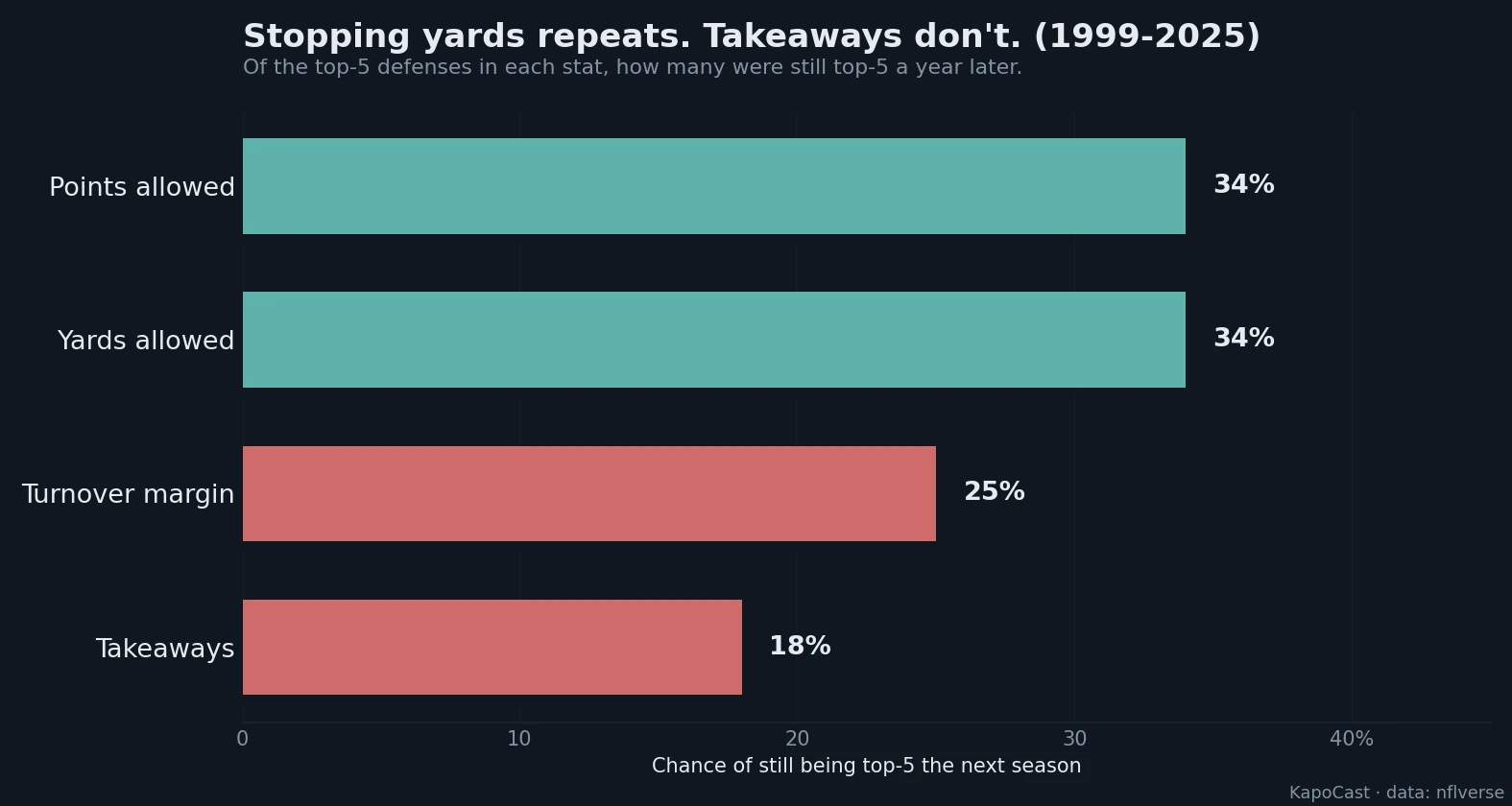
Defenses that don’t give up yards and points repeat about a third of the time, and in a league built to drag everybody back to .500, a third is a lot. Taking the ball away barely repeats at all. A top-five takeaway defense is still top-five only about one year in five, and turnover margin isn’t much better. Keeping teams from moving the ball up and down the field is a skill you keep. Taking the ball away at that high of a clip is often a wave you happened to catch.
The fumble one deserves its own flag, because it’s the purest luck of the bunch. A defense can be great at knocking the ball loose, that part is a skill, but whether it bounces to them or back to the offense is almost completely random. Over a full season a team recovers about half the fumbles in its games no matter what it does.
The Next Year
Put a real number on it. Take the five best turnover defenses in any given year and look at what those teams did the very next season.
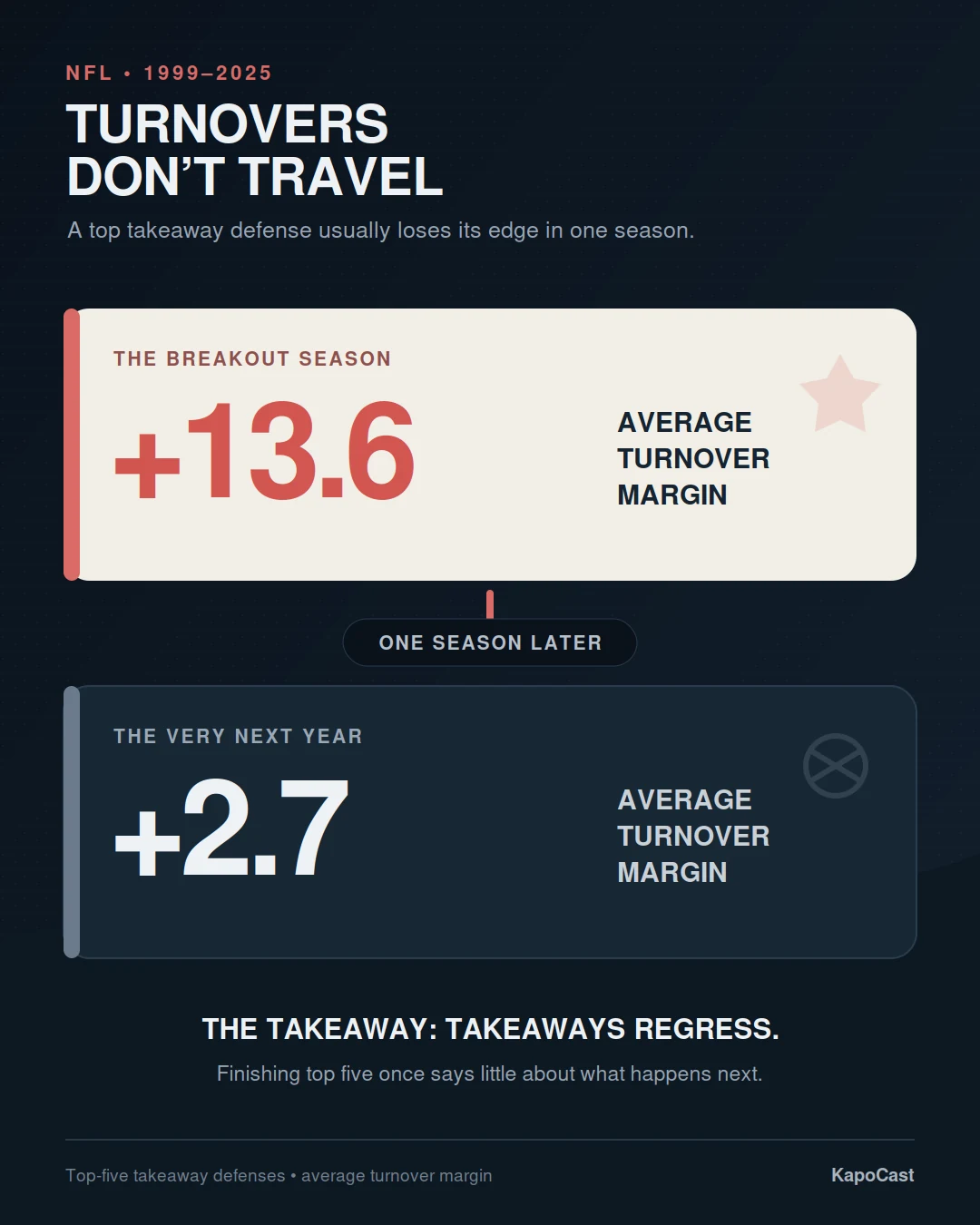
They average a plus-13.6 margin the year they’re great. The next year, the same teams average plus-2.7. They fall almost all the way back to the pack in one season. Nothing about the roster had to change dramatically. You don’t have to lose a ton of talent or coaches. The luck just evens out, the way luck always does.
NFL history is littered with these. The 2011 Packers put up a plus-28 turnover margin, the best of the century, wrapped around a defense that finished dead last in yards. The 2010 and 2012 Patriots did the same thing, monster margins hiding mediocre defenses. None of them held it. Then compare all of that to the 2000 Ravens, the best scoring defense of the era, who were elite at stopping yards AND taking the ball away. That one was real. Real is the exception, not the rule.
If you want to see what real actually looks like, here are the five best scoring defenses of the whole stretch, and the list is instructive. The 2000 Ravens allowed under ten points a game. The 2000 Titans, the 2002 Buccaneers, and both the 2001 and 2005 Bears round out the top five. Every one of them was elite at stopping yards first. The takeaways were a bonus stacked on top of a wall, not the wall itself. That is the order that lasts, and it is the exact reverse of what Chicago just did.
The Tell
So how do you catch one of these before it sells you a season of false hope? You line up how good a defense was at taking the ball away against how good it was at everything else, and you look at the distance between the two.
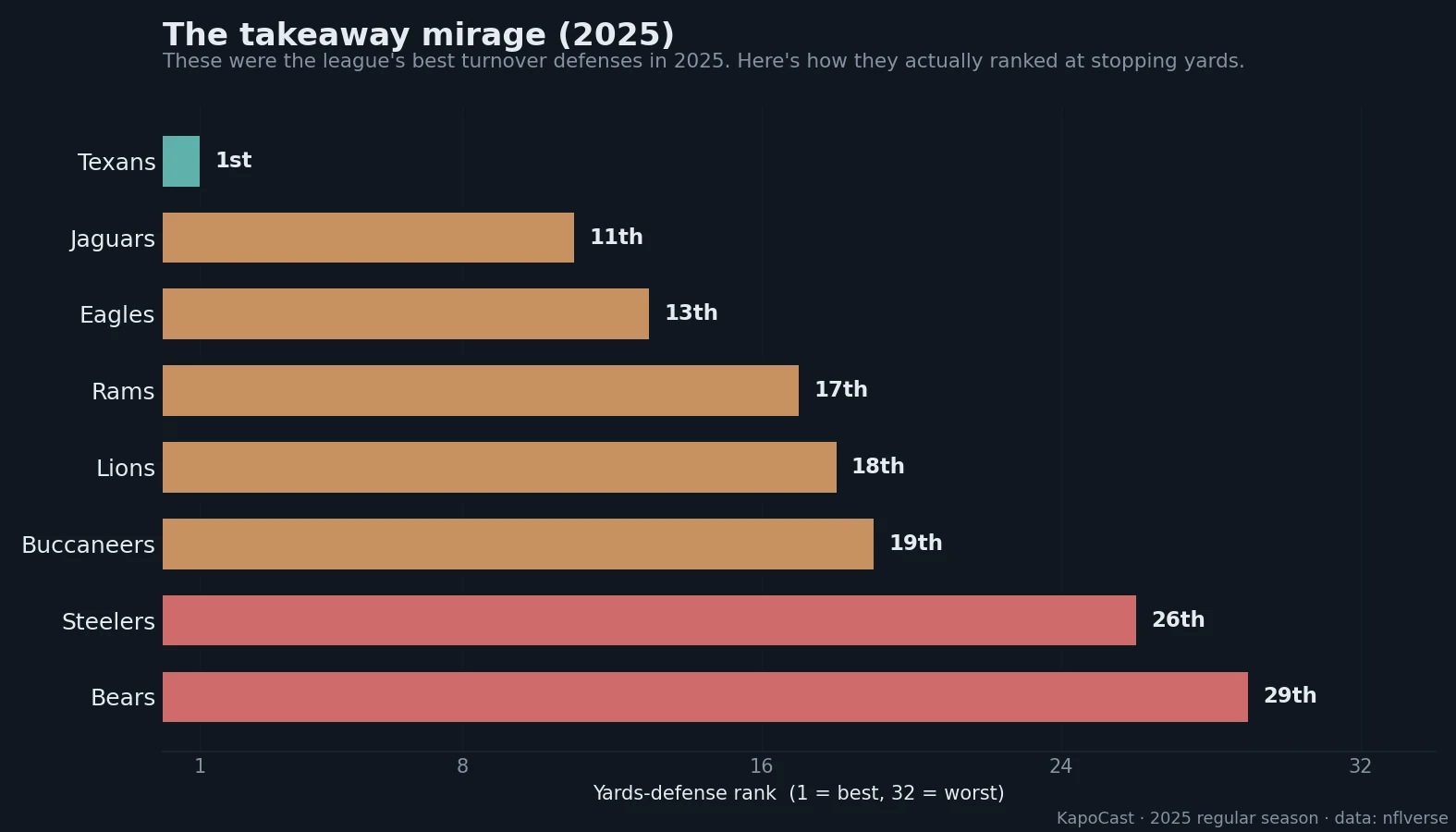
The teams near the top of both columns are the real ones. Houston led the league in yards allowed and forced its share of turnovers on top of it, so that defense was going to be good no matter how the ball bounced. The teams with a big gap are the tell. There are a few of them every year, near the top in takeaways and near the bottom in yards, and it never means what people want it to mean. A defense sitting in that corner isn’t good. It’s a bad defense held up by a takeaway number that has almost no chance of coming back.
And to be fair, takeaways aren’t nothing. Forcing them is real, good defenses pressure the quarterback and swarm the ball. But the number itself swings on things no coordinator controls. A tipped pass that hangs in the air, a quarterback having a bad day, a fumble that bounces the right way. You can build a defense that gives itself more cracks at the ball. You cannot build one that promises thirty takeaways again.
So the next time your team runs up a monster turnover margin and everyone starts talking about a defense that’s finally arrived, do one thing before you believe it. See how many yards they actually gave up. If they smothered people all year and took the ball away on top of it, you’ve got the real thing. If they were middle of the pack at everything but the giveaways, hope you get your money’s worth this season, because you probably aren’t seeing that again for a while.