
With football season here, I wanted to start focusing on who is important in the draft, especially DFS. Here is twenty-five years of fantasy scoring reduced down to what matters. Running backs and receivers are where drafts are won as we know, because the elite ones are worth roughly double an elite quarterback or tight end over what you can find on waivers. In DFS, quarterbacks are the safe floor, receivers are the boom, tight ends are a trap.
What to Draft
Start with the raw scoring, because it sets up everything else. Here is the average fantasy points per game at each rank of the depth chart, going back to 1999.
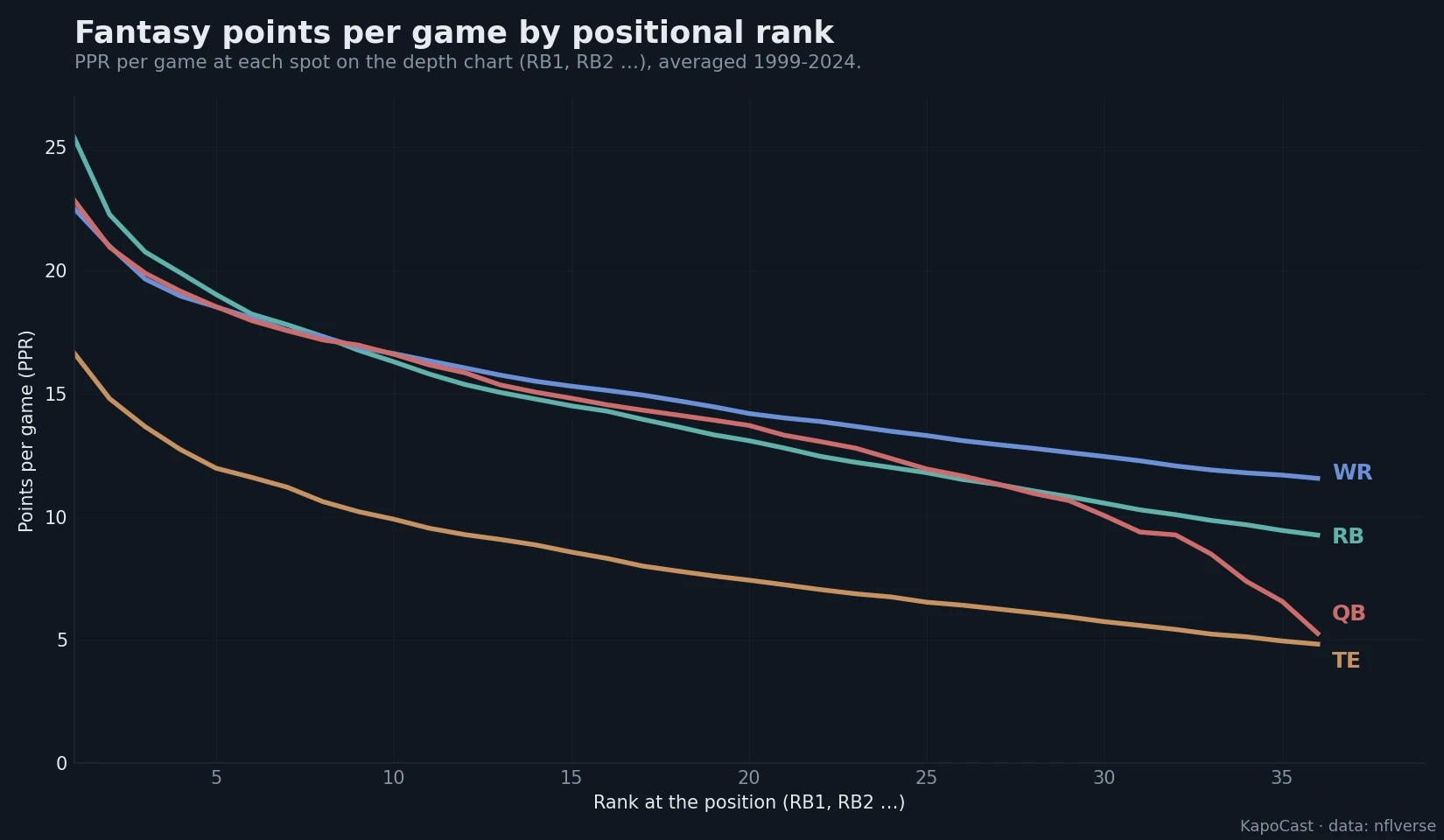
The single highest-scoring asset in all of fantasy is the RB1, at 25.4 points a game. Nothing else touches it at the very top. But look at how fast running back falls off, by RB24 it is down to 12.0. Receiver is the opposite. It starts a hair lower and barely drops, WR24 still puts up 13.5, the best mark of any position that deep. And tight end lives in the toilet the whole way down. The best tight end in a typical year averages 16.7, which is a fine RB2, and it craters from there. That depth gap shows up pretty clearly when you count how many 'usable' players each position actually produces in a season.
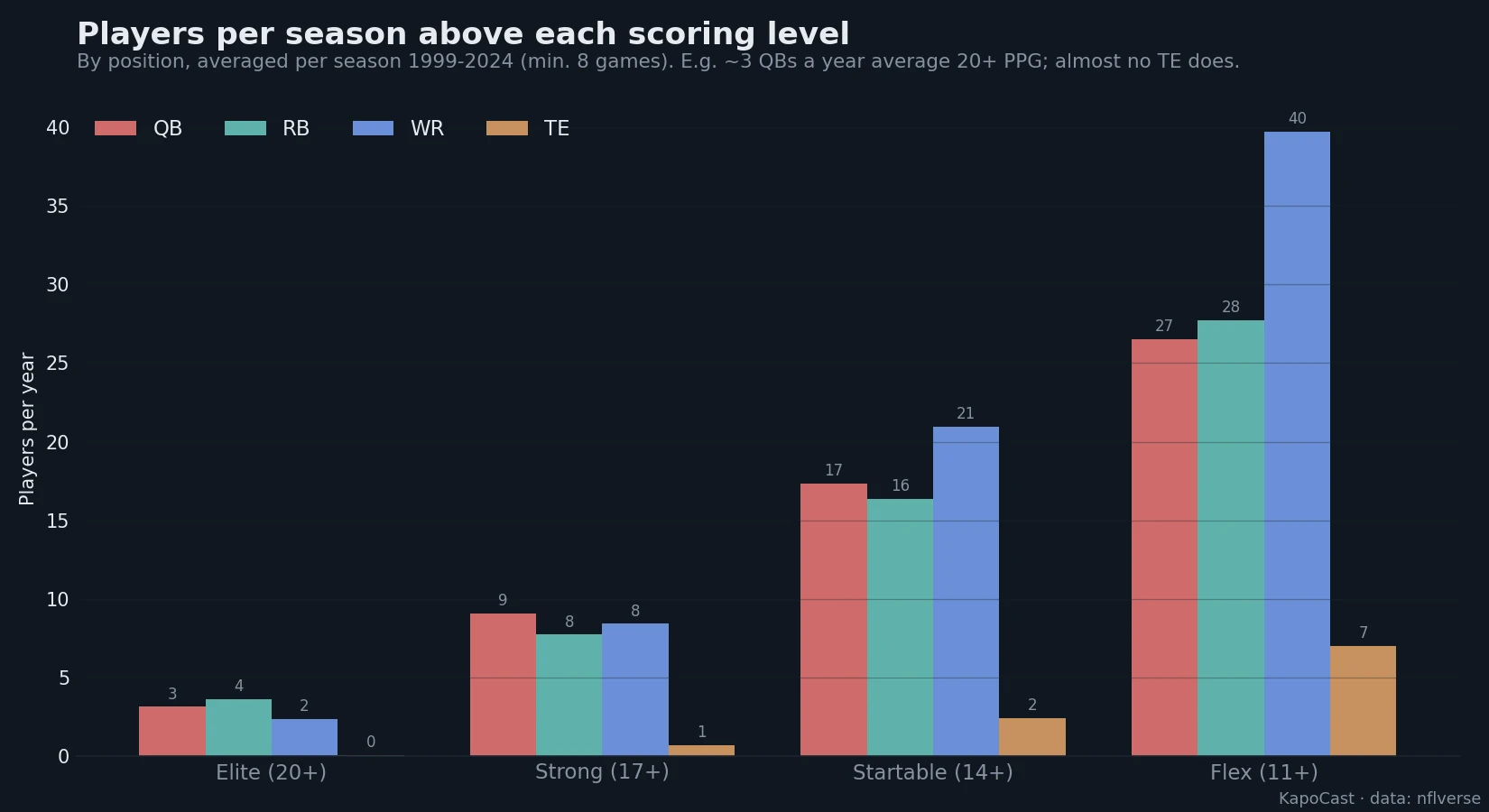
In a typical year about forty receivers average double figures. Forty. There are only seven tight ends who clear that same bar, and in most seasons exactly zero tight ends score like an elite back or receiver. So receiver is a position you can wait on and still fill your lineup out of the leftovers, while tight end is a spot where you either own one of the two good ones or you are starting a guy who might catch two balls for eleven yards.
Raw scoring isn’t draft value, though. What matters on draft day isn’t how many points a player scores, it is how many more he scores than the guy you could grab off waivers for nothing. That is value over replacement.
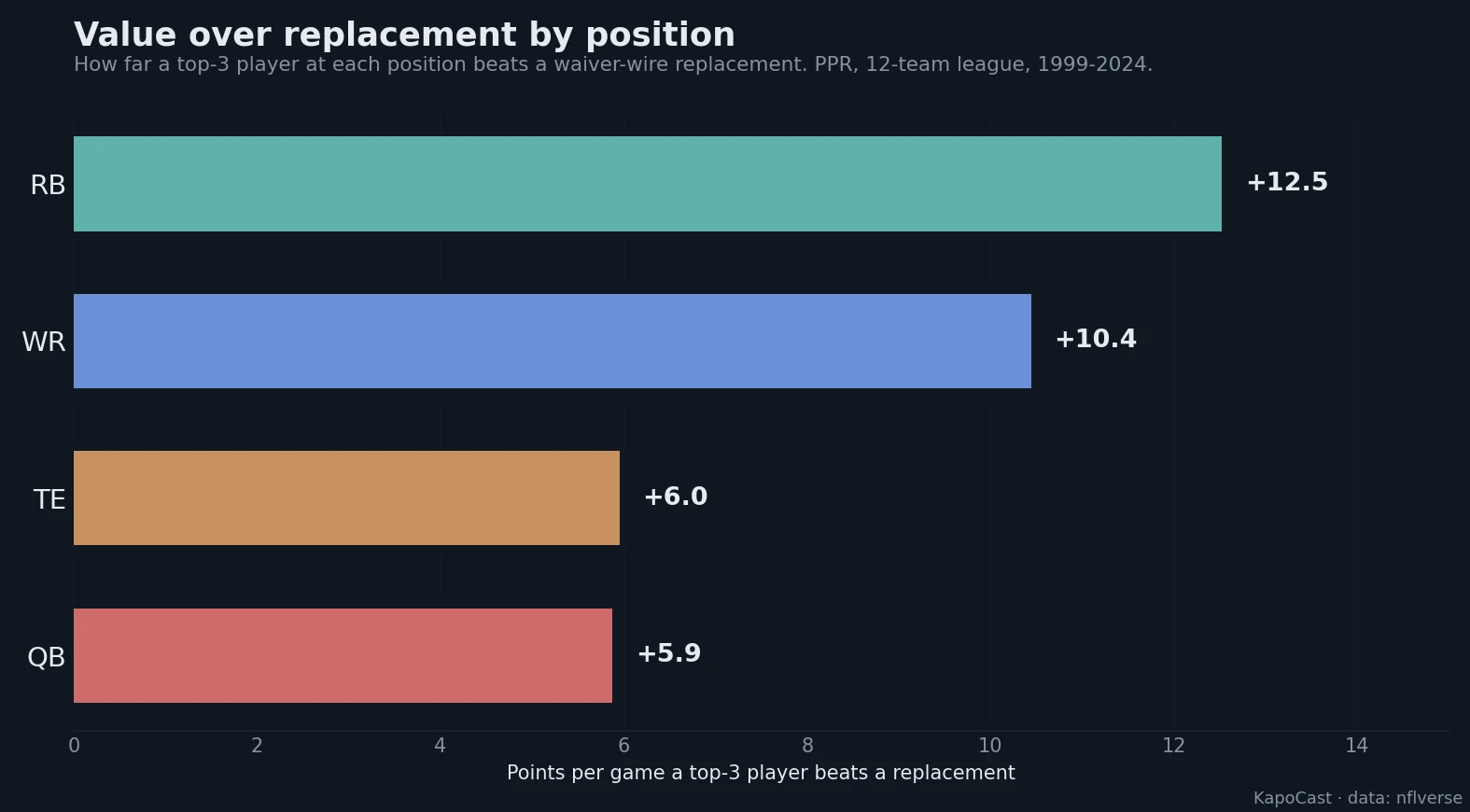
An elite running back beats a replacement-level back by 12.5 points a game. An elite receiver, 10.4. An elite quarterback or tight end? Barely six. That is the game of fantasy football. The studs at running back and receiver are worth double the studs at quarterback and tight end, because the drop to the waiver wire is so much steeper at those two spots. You draft them early because they are the hardest to replace.
And here is the part that should actually change how you draft. The value over replacement of the LAST starter at every position is basically zero. The 24th running back, the 36th receiver, the last startable quarterback, every one of them is a rounding error above the guy sitting on waivers. A solid, boring starter is worth almost nothing, because solid and boring is exactly what the free-agent pool is full of. The entire draft is a fight for the top of each position. Nothing else moves the needle.
So the plan writes itself. Hammer elite running back and receiver early, where the edge is huge. Unless you get one of the very best, wait on quarterback and tight end, where the edge is small and the replacement is nearly as good. The one exception is the generational tight end. The best tight end seasons on record, the peak Gronkowski and Kelce years, hit around 21 points a game, which turns a tight end into running-back-level value. If a guy like that is on the board, take him. Every other tight end is a position you punt.
DFS: Same Points, Different Game
Daily fantasy runs on the same scoring, so none of those numbers change. A receiver’s points are a receiver’s points whether you drafted him in August or bought him on a Sunday slate. However, in a season-long league you care about a player’s total. In DFS you care about a single week, and in a single week the shape of a position’s scoring matters more than its average.
Here are those same startable players, but instead of season averages, this is the range of their weekly outcomes, the floor of a bad week, the middle, and the ceiling of a great one.
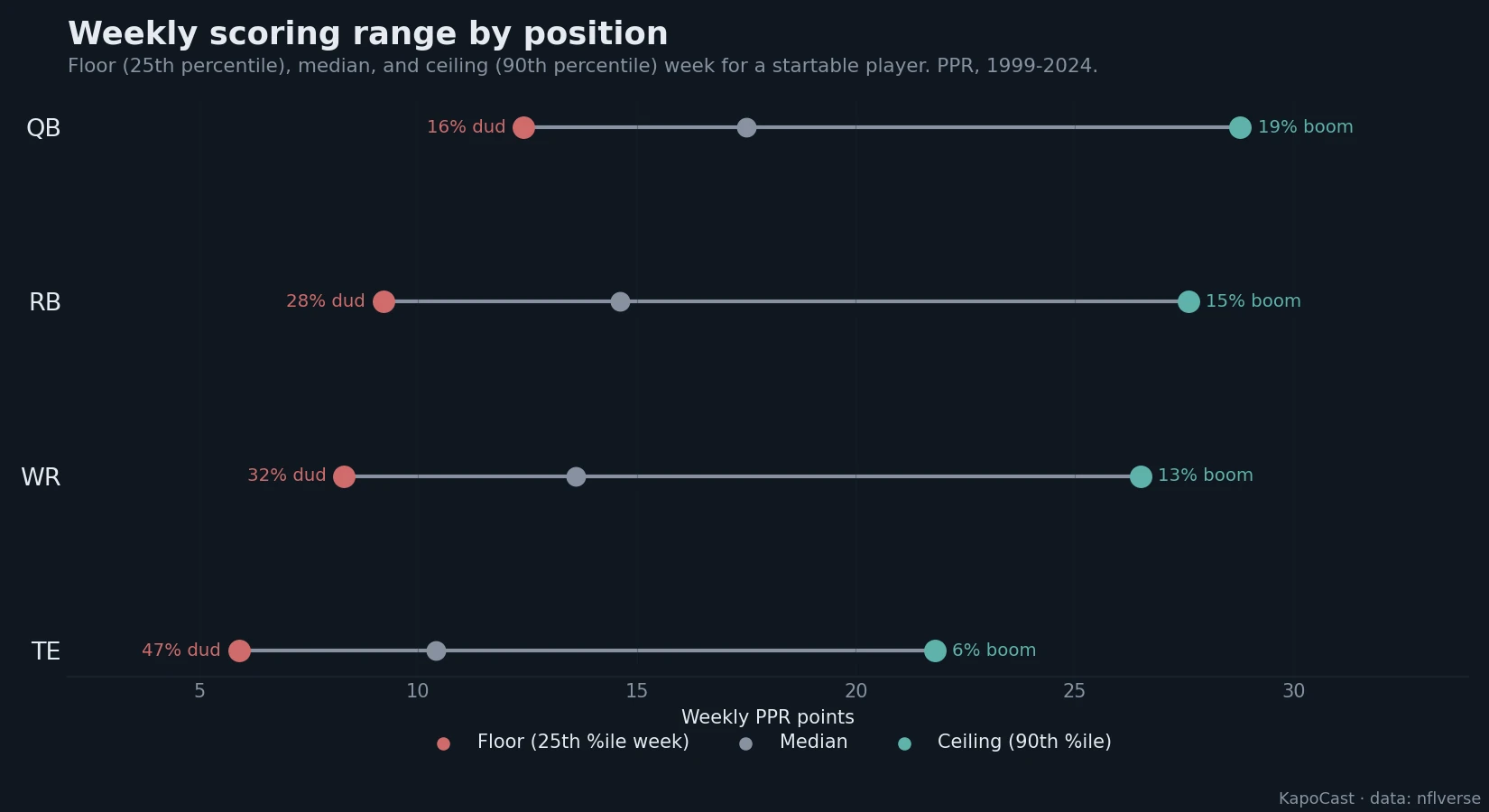
Quarterback is the safest position in fantasy on a week-to-week basis. A startable QB busts, meaning under ten points, only about one week in six, and still carries a real ceiling. Running back is next, a decent floor and a good top end. Then it gets choppy. Receivers are boom or bust, they lay a dud almost a third of the time, but the ceiling is enormous. And nearly half of all startable tight end weeks come in under ten points, on the lowest ceiling of the group. One bad tight end can quietly sink an entire lineup for the week and cost you money.
That distribution is the whole DFS game, because the two formats reward opposite things. Cash games, where you just have to beat half the field, are about floor. You want the safe points, so you build around quarterbacks, workhorse running backs, and the target hogs who see the ball no matter the script. Tournaments are about ceiling, because you need a top-heavy score to beat thousands of people, so you chase the boom, the volatile receiver, the stack that hits for four scores, the tight end nobody else played who goes for 25. Same players, same points, a completely different roster.
Every player has a price, and that price is set by what he has already been doing, which means it always lags what he is about to do. When a backup running back takes over a backfield or a receiver’s role suddenly opens up, the production jumps a week before the salary does. Those are the value plays, and they matter more in DFS than anywhere else, because a cap game is really a game of points per dollar. The trends from the draft section still hold, receiver is deep so there is always cheap receiver value, tight end is thin so paying all the way up for the rare good one can be worth it, but the specific edge every single week is finding the guy whose price hasn’t caught up yet. So the DFS version of the rule bends a little.
Quick Answers
01 What position scores the most in fantasy?
02 Should I draft a quarterback early?
03 When should I draft a tight end?
04 Is running back or receiver more valuable?
05 What’s the best DFS position for cash games?
06 Which position should I be careful with in DFS?
Pull it together and the fantasy season is two decisions with the same idea running through both. The draft is about scarcity. Spend your early picks on elite running backs and receivers, because those are the players you cannot replace, and let quarterback and tight end come to you, because the league is full of guys who score almost as much as the ones going ahead of them. Don’t pay for solid. Solid is free.
DFS is about shape. The points don’t change, but the format decides which points you want. When you need to be safe, buy floor, quarterbacks and workhorses. When you need to be first, buy ceiling, the boom receivers and the tight end nobody else dared to pick. And every week, hunt the player whose salary hasn’t caught up to a role that just changed for some reason, because a salary cap turns fantasy into a game of value.
None of it guarantees anything. Football is football and the ball takes funny bounces. But the numbers have said the same thing for twenty-five years.